
Nanotechnology in Petroleum

Nanotechnology in Petroleum Products: Enhancing Performance and Sustainability

The petroleum industry is increasingly turning to advanced technologies to improve efficiency, performance, and environmental sustainability. One of the most promising developments in recent years is the application of nanotechnology. By manipulating materials at the molecular or atomic scale, nanotechnology offers innovative ways to enhance the properties of fuels and lubricants, reduce emissions, and optimize refining processes.

What is Nanotechnology in Petroleum?

Nanotechnology involves engineering materials at the nanometer scale (1–100 nanometers) to create structures with unique physical, chemical, and mechanical properties. In petroleum products, nanoparticles can be incorporated into fuels, lubricants, and additives to improve combustion efficiency, reduce wear and tear, and minimize environmental impact.

Applications of Nanotechnology in Petroleum Products

  1. Fuel Performance Enhancement
    • Improved combustion efficiency: Nanoparticles such as cerium oxide, aluminum oxide, or titanium dioxide act as catalysts, enhancing fuel oxidation and improving energy output.
    • Lower emissions: Nanoparticles reduce incomplete combustion, leading to lower emissions of carbon monoxide (CO), hydrocarbons (HC), and particulate matter.
    • Stability and storage: Nano-additives can prevent fuel degradation over time, maintaining consistent performance in storage tanks.
  2. Lubricant Optimization
    • Reduced friction and wear: Metal and carbon-based nanoparticles, like graphene and molybdenum disulfide, create a protective layer on engine components, reducing friction and extending equipment life.
    • Higher thermal stability: Nano-lubricants resist high temperatures, making them suitable for heavy machinery and high-performance engines.
    • Energy efficiency: Reduced mechanical losses translate to lower fuel consumption and greenhouse gas emissions.
  3. Enhanced Refining Processes
    • Catalysis in hydrocracking and desulfurization: Nanocatalysts increase reaction efficiency, allowing refineries to process heavier crude and reduce sulfur content in fuels.
    • Waste minimization: Nanomaterials improve reaction selectivity, reducing unwanted by-products and chemical waste.
  4. Environmental and Sustainability Benefits
    • Emission reduction: By improving combustion and lubrication efficiency, nanoparticles contribute to lower CO₂ and pollutant emissions.
    • Cleaner production: Nano-catalysts in refining allow for more precise chemical reactions, reducing the environmental footprint of petroleum products.
    • Integration with alternative fuels: Nanotechnology can enhance biofuels and synthetic fuels, improving energy density and stability while supporting the transition to low-carbon energy.

Challenges and Considerations

While nanotechnology offers significant benefits, it comes with challenges:

  • Cost: Manufacturing and integrating nanoparticles can be expensive, requiring specialized equipment and expertise.
  • Health and safety: Some nanoparticles pose health risks if inhaled or released into the environment, necessitating strict safety protocols.
  • Regulatory hurdles: Standards for nanoparticle use in fuels and lubricants are still evolving, which can impact commercial adoption.
  • Scalability: Moving from laboratory applications to large-scale production remains a technical challenge for many nano-enhanced petroleum products.

The use of nanotechnology in petroleum products is expected to expand as research advances and costs decrease. Key trends include:

  • Broader adoption of nano-additives in commercial fuels and lubricants.
  • Integration of nanomaterials with renewable fuels and low-carbon energy solutions.
  • Development of environmentally friendly nanoparticles that combine performance enhancement with minimal ecological impact.

Nanotechnology represents a transformative approach to improving petroleum products. From boosting fuel efficiency and reducing emissions to optimizing lubrication and refining, nanoparticles are enabling the petroleum industry to achieve higher performance and sustainability standards. As technological development continues, nanotechnology will play an increasingly central role in bridging the gap between traditional petroleum operations and the low-carbon energy future.


Read more on Sparkview Energy:

Digital Twin Technology in Offshore Oil and Gas: Enhancing Safety and Efficiency

Upstream Innovations: How Technology is Enhancing Petroleum Product Yield
Environmental Innovations in Oil Spill Cleanup Technology

Carbon-Neutral

The Transition to Carbon-Neutral Trading: Challenges and Opportunities

The global energy sector is undergoing a profound transformation. Increasingly stringent climate policies, investor pressure, and public demand for sustainability are pushing energy companies and traders toward carbon-neutral operations. For petroleum and energy traders, achieving carbon neutrality is not just an environmental goal; it is a strategic imperative that reshapes risk management, market opportunities, and operational models.

Understanding Carbon-Neutral Trading

Carbon-neutral trading refers to balancing greenhouse gas emissions generated by trading activities with equivalent carbon reductions or offsets. For energy traders, this can involve:

  • Reducing emissions in physical operations such as shipping, storage, and transport.
  • Utilizing low-carbon or zero-carbon fuels, including LNG, biofuels, and hydrogen.
  • Investing in carbon credits or nature-based offsets to neutralize unavoidable emissions.

The goal is to maintain profitability while aligning with international climate targets, including the Paris Agreement’s net-zero ambitions.

Opportunities in the Carbon-Neutral Transition

  1. Market Differentiation and Reputation
    Companies that embrace carbon-neutral trading enhance their brand credibility with clients, investors, and regulators. Sustainability credentials can open doors to partnerships and new markets, particularly with corporations seeking low-carbon fuel supply chains.
  2. Access to Emerging Carbon Markets
    Carbon pricing and trading are becoming increasingly mainstream. Traders can capitalize on carbon markets by buying, selling, and hedging carbon credits. These markets offer both risk management tools and new revenue streams.
  3. Innovation in Low-Carbon Energy Products
    Transitioning to carbon neutrality drives innovation, such as:

    • Trading renewable energy certificates (RECs) alongside fossil fuels.
    • Expanding into biofuels, synthetic fuels, and hydrogen.
    • Integrating data-driven tools to optimize logistics and minimize carbon footprints.
  4. Regulatory Alignment and Risk Reduction
    Governments are introducing stricter emissions reporting and compliance requirements. Early adopters of carbon-neutral practices are better positioned to navigate regulatory landscapes, avoid penalties, and leverage incentives such as carbon credits or tax breaks.

Challenges in the Transition

  1. Measurement and Reporting Complexity
    Calculating the carbon footprint of trading operations—covering shipping, storage, procurement, and upstream activities—is complex. Accurate measurement requires advanced data analytics and standardized methodologies.
  2. Supply Chain Constraints
    Procuring low-carbon fuels and ensuring green logistics can be challenging due to limited infrastructure, high costs, or a lack of consistent supply.
  3. Financial Costs and Investment
    Implementing carbon-neutral operations often requires upfront investments in technology, monitoring systems, and offsets, which may impact short-term margins.
  4. Market Volatility and Policy Uncertainty
    Carbon markets are still evolving, and policies differ across regions. Traders must navigate fluctuating carbon prices, changing regulations, and varying standards for certification.

Strategic Steps for Traders

  • Adopt Carbon Accounting Tools: Implement digital platforms that track emissions across all operations.
  • Engage in Low-Carbon Fuel Trading: Diversify portfolios to include biofuels, LNG, hydrogen, and other low-carbon alternatives.
  • Leverage Offsets Strategically: Invest in high-quality carbon credits or local environmental projects to balance emissions.
  • Collaborate Across the Value Chain: Work with suppliers, logistics partners, and clients to reduce emissions collectively.

The transition to carbon-neutral trading is inevitable for the energy sector. Traders who proactively integrate sustainability into strategy, operations, and risk management will not only comply with regulations but also gain a competitive advantage. While the challenges are significant, the opportunities from new markets to innovation leadership are equally compelling.

Carbon-neutral trading represents both a challenge and a strategic opportunity for the petroleum and energy trading industry. By embracing data-driven tools, low-carbon products, and collaborative solutions, traders can reduce environmental impact, manage risk, and create long-term value. The future of energy trading will be defined not just by price and supply but by sustainability, innovation, and the ability to operate responsibly in a carbon-constrained world.


Read more on Sparkview Energy:

Green Hydrogen: A Game Changer for Decarbonizing the Oil and Gas Industry

Carbon Capture and Storage: Transforming Emissions into Opportunity

Green Equipment: Reducing the Carbon Footprint of Petroleum Operations

Offshore Equipment

How Supply Chain Disruptions Are Affecting Petroleum Equipment Availability

The petroleum industry depends on a highly specialized and interconnected supply chain. From drilling rigs and compressors to storage tanks and control valves, every piece of equipment plays a role in ensuring operations run smoothly. But in recent years, supply chain disruptions driven by global crises, shifting trade policies, and market volatility have created bottlenecks that are directly affecting equipment availability.

For operators, contractors, and traders, the consequences are far-reaching: higher costs, longer project timelines, and increased operational risk.

The Roots of the Disruptions

Several factors have converged to strain petroleum equipment supply chains:

  1. Global Logistics Delays
    The COVID-19 pandemic exposed the fragility of global shipping networks. Congested ports, container shortages, and shipping backlogs continue to cause unpredictable lead times for petroleum equipment.
  2. Geopolitical Tensions
    Trade disputes, sanctions, and shifting alliances—particularly involving major manufacturing hubs like China, the U.S., and Europe—have complicated procurement. Export controls on sensitive technologies, such as drilling software and advanced sensors, have further slowed deliveries.
  3. Raw Material Shortages
    Many petroleum components rely on specialty steels, alloys, and electronic chips. Global shortages of these materials, combined with rising energy costs for manufacturing, have pushed equipment prices upward.
  4. Labor and Skilled Workforce Constraints
    Skilled labor shortages in manufacturing and logistics have reduced production capacity for pumps, valves, and control systems. This has been compounded by rising demand for renewable energy equipment, which competes for the same resources.
  5. Energy Transition Pressures
    Some suppliers are scaling back petroleum-focused production in favor of renewable or low-carbon technologies. This shift has reduced the diversity of suppliers available for traditional petroleum equipment.

Impacts on Petroleum Operations

The disruptions are not just logistical—they are reshaping project economics and timelines across the sector:

  • Longer Lead Times: Equipment that once took three months to procure can now take nine months or more, delaying drilling campaigns and refinery upgrades.
  • Rising Capital Expenditure: Higher equipment costs are inflating project budgets, especially for midstream and downstream infrastructure.
  • Operational Risks: Spare parts shortages are forcing operators to extend the life of existing equipment, increasing maintenance risks.
  • Regional Inequality: Emerging markets, particularly in Africa and Southeast Asia, face steeper challenges due to limited local manufacturing capacity and higher dependence on imports.

Strategies for Building Resilience

To adapt, petroleum companies are rethinking how they manage supply chains:

  1. Localization of Manufacturing
    Some operators are partnering with local workshops and engineering firms to fabricate parts regionally, reducing reliance on overseas suppliers.
  2. Strategic Inventory Management
    Companies are shifting from “just-in-time” models to holding larger inventories of critical spares, especially for pumps, compressors, and safety equipment.
  3. Diversification of Suppliers
    Engaging multiple vendors across different regions spreads risk and reduces vulnerability to disruptions in a single country.
  4. Digital Procurement Platforms
    Advanced procurement systems are helping companies track supply chain risks, compare supplier reliability, and forecast shortages more accurately.
  5. Collaboration Across the Value Chain
    Joint procurement initiatives between operators, contractors, and governments are emerging, helping secure bulk orders at better terms.

The petroleum industry’s reliance on complex global supply chains means disruptions will continue to be a structural risk. However, these challenges also present an opportunity for modernization. By adopting digital tools, investing in local manufacturing, and building flexible supply strategies, operators can secure the equipment they need while reducing exposure to global volatility.

Supply chain disruptions are reshaping petroleum equipment availability in ways that affect cost, timelines, and risk management. Companies that treat resilience as a strategic priority rather than a temporary adjustment will be better positioned to navigate uncertainty and sustain operational efficiency in a shifting energy landscape.


Read more on Sparkview Energy:

Understanding AI and Machine Learning in Petroleum Equipment

Robotic Solutions in Petroleum Equipment: Enhancing Safety and Precision

Adapting Offshore Equipment for Midshore Environments: A Cost-Effective Solution

Blockchain in Petroleum Trading

Blockchain in Petroleum Trading: Ensuring Transparency and Efficiency

The petroleum trading industry has long been characterized by complex supply chains, multiple intermediaries, and high-value transactions. While these processes are essential for moving crude oil and refined products globally, they also create challenges ranging from documentation errors to a lack of transparency and delayed payments. Blockchain technology is emerging as a transformative solution, offering enhanced transparency, efficiency, and trust across petroleum trading operations.

What is Blockchain?

Blockchain is a decentralized, digital ledger that records transactions in a secure, tamper-proof manner. Each transaction is verified by multiple parties and stored in a chain of blocks, creating an immutable record. In petroleum trading, blockchain can streamline transactions, automate contracts, and provide real-time visibility into the movement of commodities.

Challenges in Traditional Petroleum Trading

Before blockchain, petroleum trading faced several persistent challenges:

  • Complex documentation: Bills of lading, letters of credit, and regulatory compliance documents often require manual verification, increasing the risk of errors and delays.
  • Lack of transparency: Multiple intermediaries can make it difficult to track product ownership, shipment status, and financial settlements.
  • Operational inefficiencies: Manual processes slow down trade execution and settlement, tying up working capital.
  • Fraud and disputes: Paper-based processes and delayed verification increase the risk of disputes and financial losses.

How Blockchain Transforms Petroleum Trading

  1. End-to-End Transparency
    Blockchain provides all participants, traders, refiners, shipping companies, and regulators with a shared, real-time view of transactions. This reduces information asymmetry, builds trust, and allows instant verification of cargo ownership, origin, and quality.
  2. Smart Contracts for Automation
    Smart contracts are self-executing agreements stored on a blockchain. They can automatically trigger payments, release shipments, or enforce compliance once predefined conditions are met. This reduces delays, lowers administrative costs, and minimizes human error.
  3. Enhanced Efficiency and Reduced Costs
    By digitizing and securing trade documentation, blockchain eliminates the need for repetitive checks and manual reconciliations. Settlement times can be reduced from days or weeks to hours, freeing up working capital and improving cash flow.
  4. Improved Risk Management
    Immutable records on a blockchain provide a reliable audit trail, reducing the risk of fraud, disputes, and regulatory non-compliance. Traders can quickly verify transaction history and product provenance, supporting due diligence and ESG reporting.
  5. Integration with IoT and Data Analytics
    When combined with Internet of Things (IoT) sensors, blockchain can track petroleum shipments in real time—monitoring location, temperature, and pressure. Advanced analytics on this data enables proactive risk mitigation and operational optimization.

Real-World Examples

Several blockchain initiatives are already reshaping petroleum trading:

  • Vakt Platform: A blockchain-based post-trade management platform that digitizes commodities trade documentation, reducing paperwork and streamlining settlement.
  • Energy Web and Shell Collaboration: Using blockchain to track renewable energy credits and improve transparency in low-carbon fuel supply chains.
  • BP and Equinor Pilot Projects: Testing blockchain for LNG trade to improve efficiency, reduce reconciliation delays, and enhance transparency.

Challenges to Adoption

Despite its promise, blockchain adoption in petroleum trading faces obstacles:

  • Industry standardization: Multiple platforms and protocols require agreement on standards and interoperability.
  • Regulatory acceptance: Authorities must recognize digital records and smart contracts as legally binding.
  • Initial investment: Implementing blockchain solutions requires technology, training, and integration with legacy systems.
  • Change management: Stakeholders must adapt to new workflows and trust digital verification over traditional processes.

Blockchain technology has the potential to redefine petroleum trading by ensuring transparency, efficiency, and security. While adoption requires careful planning, standardization, and collaboration, early movers stand to gain a competitive edge in a complex, high-value industry. As the global energy market continues to evolve, blockchain-enabled trading represents a step toward a more streamlined, trustworthy, and digitally connected petroleum sector.


Read more on Sparkview Energy:

Emerging Technologies in Midshore Exploration and Production: Bridging the Gap Between Shallow and Deep Waters

Understanding AI and Machine Learning in Petroleum Equipment

Drones in Midshore Oil and Gas: Enhancing Inspection and Monitoring

Oil Spill Prevention

Oil Spill Prevention and Response Strategies for Midshore Platforms

Midshore oil and gas platforms located between nearshore and deepwater operations play a crucial role in global petroleum production. While these platforms offer economic and logistical advantages, they also face significant operational risks, including oil spills. Preventing and responding to spills is critical not only for environmental protection but also for regulatory compliance, corporate reputation, and operational continuity.

Understanding Midshore Platforms

Midshore platforms typically operate in water depths ranging from 20 to 200 meters. They often serve as production hubs for multiple wells and may involve complex logistics for transportation, processing, and storage. The proximity to coastlines increases environmental sensitivity and the need for robust spill prevention and response systems.

Key Oil Spill Prevention Strategies

  1. Robust Well Design and Maintenance
    • Blowout preventers (BOPs): Installing and regularly testing high-integrity BOP systems reduces the risk of uncontrolled hydrocarbon releases.
    • Regular inspections: Structural integrity of pipelines, risers, and storage tanks should be routinely assessed using non-destructive testing and remote monitoring systems.
  2. Advanced Monitoring Systems
    • Real-time sensors: Flow meters, pressure sensors, and leak detectors can quickly identify anomalies that indicate potential spills.
    • Remote monitoring: Satellite imagery, drones, and underwater autonomous vehicles (AUVs) provide early detection of leaks and surface oil.
  3. Operational Controls and Training
    • Standard operating procedures (SOPs): Ensuring that all personnel follow stringent procedures during drilling, production, and transfer reduces human error.
    • Simulation exercises: Regular training and spill response drills prepare staff for rapid, coordinated action during emergencies.
  4. Containment Systems
    • Secondary containment: Bunds, berms, and double-walled tanks help prevent accidental release from reaching the marine environment.
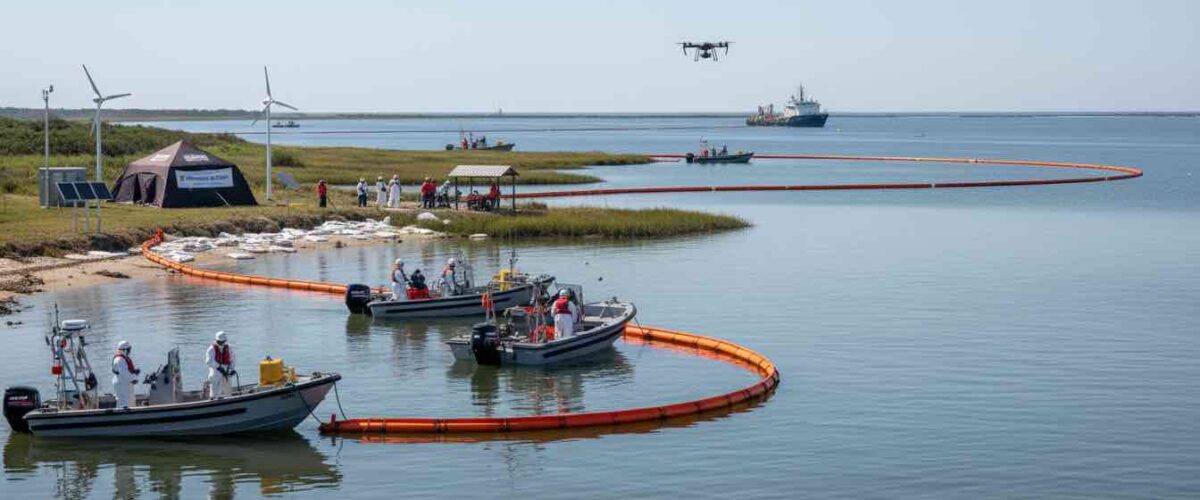
    • Booms and skimmers: Pre-deployed equipment can contain and recover oil before it spreads.

Effective Oil Spill Response Strategies

  1. Rapid Mobilization and Communication
    • Establishing an Incident Command System (ICS) ensures clear leadership and communication among platform operators, regulators, and emergency responders.
    • Early notification protocols reduce response times and limit environmental impact.
  2. Mechanical Recovery
    • Booms: Floating barriers contain oil on the water surface.
    • Skimmers: Mechanical skimmers remove oil from the water for storage and proper disposal.
  3. Chemical and Biological Methods
    • Dispersants: Chemicals break down oil into smaller droplets, enhancing natural biodegradation—but require careful environmental assessment.
    • Bioremediation: Microbial agents accelerate the breakdown of oil in controlled, monitored environments.
  4. Environmental Monitoring and Impact Assessment
    • Post-spill, continuous monitoring of water, sediment, and marine life is essential to evaluate ecological impact and guide remediation.
    • Data-driven assessments inform adaptive management strategies and regulatory reporting.

Regulatory and Industry Standards

Midshore platforms operate under strict regulatory frameworks to ensure spill prevention and response readiness:

  • International Maritime Organization (IMO) guidelines for oil pollution preparedness and response.
  • OSPAR Convention regulations for operations in the North-East Atlantic.
  • National standards, including U.S. Bureau of Safety and Environmental Enforcement (BSEE) and EU environmental directives, mandate contingency planning, training, and equipment readiness.

Future Trends in Spill Prevention and Response

  • Digital twin technology: Real-time virtual models of platforms help simulate spill scenarios and optimize preventive measures.
  • AI-based predictive maintenance: Machine learning algorithms predict equipment failures before they occur, reducing risk.
  • Enhanced recovery techniques: New materials and robotic systems improve efficiency in oil capture and environmental restoration.

Oil spill prevention and response on midshore platforms require an integrated approach combining technology, training, and regulatory compliance. From advanced monitoring and containment systems to rapid response protocols and environmental remediation, operators must continuously adapt to emerging risks. By prioritizing prevention and preparedness, midshore platforms can protect marine ecosystems, maintain operational integrity, and ensure sustainable energy production.


Read more on Sparkview Energy:

Environmental Innovations in Oil Spill Cleanup Technology

Crisis Management in Midshore Operations: Planning for the Unexpected

Drones in Midshore Oil and Gas: Enhancing Inspection and Monitoring